

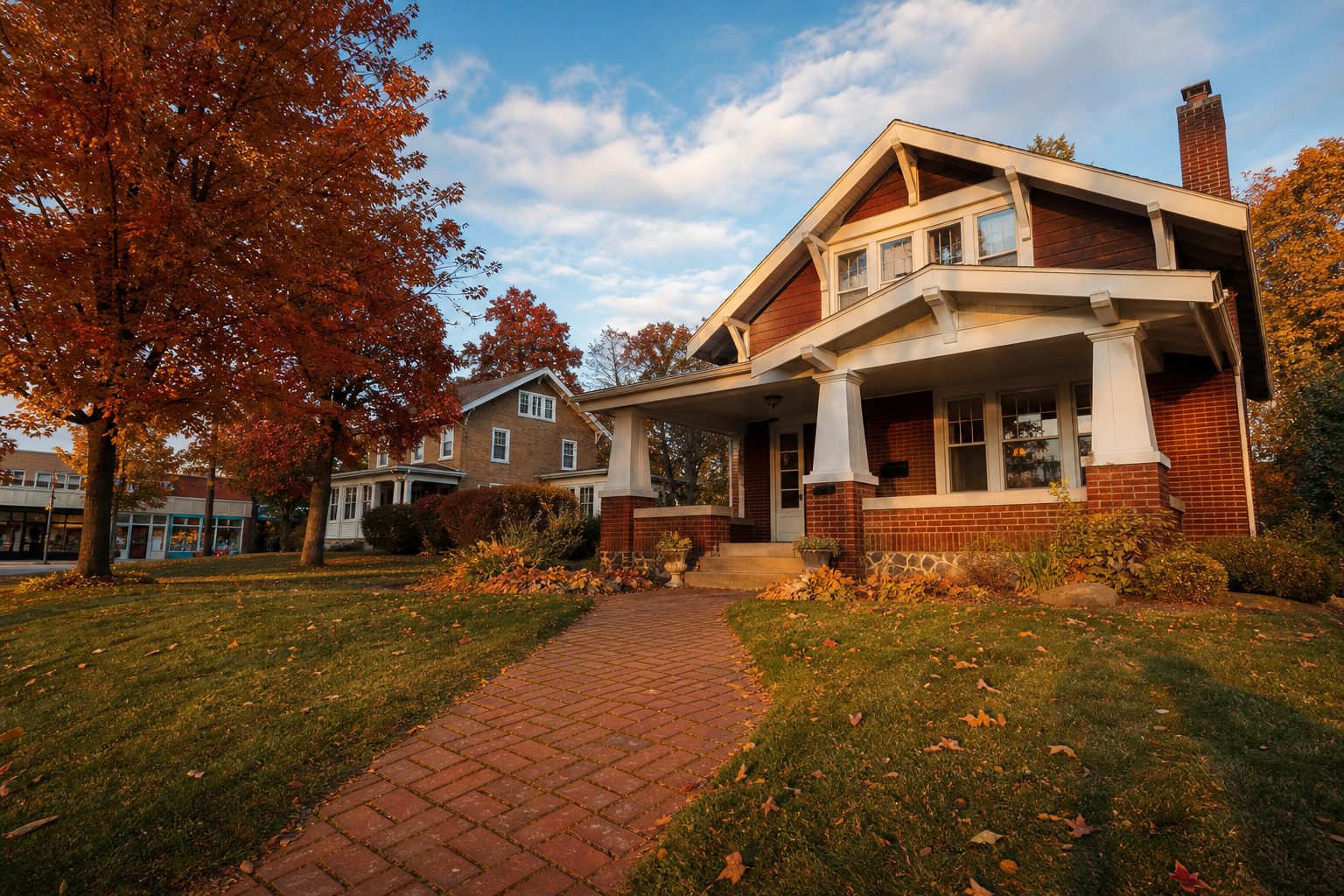
Is an income property in Madison, WI worth the time and money it takes to buy, manage, and maintain?
Yes, for most investors willing to play the long game. Madison’s combination of strong appreciation, a massive renter population, and recession-resistant employment makes income property a solid wealth-building vehicle, even if month-one cash flow looks thin on paper.
Why This Matters Right Now in Madison
You’re asking this question at an interesting moment. Madison’s median sale price hit $436,809 in Q1 2026, up 4.3% year-over-year and a full 25% above where it sat in 2022, according to Voice of Alexandria reporting on regional housing data. At the same time, 53% of Madisonians rent their homes, per the City of Madison’s 2026 Housing Snapshot Report. That is not a typo. The majority of people living in this city are renters.
So you have a market where prices keep climbing, inventory stays painfully tight (just 0.87 months of supply as of March 2026, per South Central Wisconsin MLS data), and more than half the population needs a place to rent. If you’re sitting on the fence wondering whether real estate in Madison, WI pencils out as an investment, those fundamentals should grab your attention.
But fundamentals alone do not answer the question. Let’s dig into what the numbers actually look like when you run them, neighborhood by neighborhood.
The Real Numbers Behind Madison Rental Returns
Here is where most investors get tripped up. You look at the city-wide median residential cap rate of 1.73%, per CapRateCity’s 2026 data (based on a $435,000 median home price, $1,660/month median rent, 1.85% property tax, and 4.4% vacancy), and your first thought is probably: “That’s terrible.”
And you’d be right, if cash flow on day one were the only metric that mattered. But Madison is not a cash-flow market in the traditional sense. It is an appreciation market with rental income that helps offset your hold costs while the asset climbs in value.
Consider the math over a longer horizon:
- Appreciation trajectory: Home prices have risen 25% since 2022, per regional market data. On a $435,000 property, that represents roughly $109,000 in equity growth in four years.
- Rent growth support: Madison rents are up 47% over the last five years, according to Isthmus reporting on local housing data, though the pace has slowed recently as vacancy rates creep toward healthier levels.
- Vacancy protection: The stabilized rental vacancy rate sits at 4.8%, per the City of Madison’s official data, and the lowest-cost rental tier has just a 4.6% vacancy rate, reflecting pent-up demand.
What does that actually mean for your wallet? It means you are unlikely to have a vacant unit gathering dust for months. The tenant pool here is deep, educated (59.9% of adults hold a bachelor’s degree or higher, per state demographic data), and employed. Madison’s unemployment rate was just 2.9% as of mid-2026, according to the U.S. Bureau of Labor Statistics.
Where in Madison the Numbers Work Best
Madison has a great mix of residential rental properties, and that variety is exactly what gives you options as an investor. From well-maintained duplexes along Williamson Street to Mid-Century bungalows near Monroe Street, each neighborhood offers a different risk-reward profile.
Marquette (Near East Side)
The Marquette neighborhood commands a current median home price of $695,000, per hyperlocal market data. That is premium pricing, driven by walkability to the Capitol, Lake Monona access, and the fiercely independent commercial corridor along Willy Street (where the Willy Street Co-op anchors a local-first economy). Average 1-bedroom rents here run $1,815/month, with single-family home rents hitting $2,100/month.
Near East properties approach 0.5% to 0.6% monthly rent-to-price ratios, per neighborhood-level analysis. That is below the often-cited 1% rule, but the forced appreciation potential over a six-year hold changes the return profile significantly. Mixed-use properties like the building at 1054 Williamson Street, which features two residential units and one established restaurant tenant, represent the kind of creative deal structure this neighborhood rewards.
Dudgeon-Monroe
If you are looking for stability and tenant quality, Dudgeon-Monroe is where you pay a premium for both. The median home price here is $743,237 with a median rent of $1,932/month. Monroe Street’s walkable retail scene, from Bradbury’s Coffee to Fromagination, and the proximity to Lake Wingra make this a neighborhood tenants rarely want to leave. Lower turnover means lower costs.
The Value Play: South Madison and Beltline Corridor
For investors who need a more accessible entry point, South Madison and the Beltline corridor offer homes priced from the low $200,000s up through $350,000, per city-wide price range data. Your rent-to-price ratios improve here, though competition for sub-$350,000 properties is fierce because fewer homes are available in that range.
The Time Cost Nobody Warns You About in Madison
Having closed over 300 transactions and worked extensively with rental property and investment property buyers throughout my 12 years in this market, I can tell you the money question is actually the easier half. The time question is what separates investors who succeed from those who sell at a loss three years later.
Here is what you should budget for in terms of your time:
- Acquisition phase: In a market with 0.87 months of supply, finding and closing on the right property can take three to six months of active searching. You are competing with owner-occupants, and sellers often prefer them.
- Tenant management: Even in a market with 4.8% vacancy, you still need to screen tenants, handle maintenance requests, and navigate Wisconsin landlord-tenant law. Self-managing one or two units is realistic. Beyond that, you’re looking at property management fees that eat into already-thin margins.
- Maintenance on older housing stock: The Marquette neighborhood’s craftsman bungalows and Dudgeon-Monroe’s Mid-Century homes have character, but character comes with older plumbing, original windows, and foundation quirks. Budget both money and weekend hours accordingly.
- Regulatory awareness: Madison has specific short-term rental regulations that you need to understand before assuming Airbnb income. The city had 427 active short-term rental listings earning an average of $37,700 per year, with 69% average occupancy and a $172 average daily rate, per AirDNA data as of 2026. Revenue is up 71.5% year-over-year, but active listings have dropped 33.5%, suggesting the regulatory environment is thinning the field.
Is it worth the time? If you treat it as a business with systems, yes. If you treat it as passive income, you will be disappointed.

Why Madison’s Economic Engine Protects Your Investment
You can buy an income property in a cheap market with great cash-flow ratios and still lose money if the local economy cannot sustain rental demand. Madison does not carry that risk.
The city’s employment base is anchored by Epic Systems, UW-Madison, UW Health, and the state government. The strongest sectors in 2026 are healthcare IT, life sciences, education, and state government. That diversification matters because no single employer or industry going through a rough patch can crater your tenant pool overnight.
Population growth reinforces the demand picture. Madison’s 2026 population is 288,589, growing at 0.82% annually, with planners projecting almost 100,000 more residents by 2050, per the City of Madison’s official growth data. More people means more demand for housing that is already in critically short supply.
What I tell my clients is straightforward: you are buying into a market where the structural tailwinds (population growth, job stability, constrained supply) are doing most of the heavy lifting. Your job is to buy right, manage well, and hold long enough for those tailwinds to work.
Long-Term Rentals vs. Short-Term Rentals in Madison
This is a question that comes up constantly. The short answer: both can work, but they serve different investor profiles.
Long-term rental profile:
- Median gross rent of $1,364/month city-wide, per ACS 2020-2024 data from state demographic sources
- Lower management intensity
- Consistent, predictable income
- Better suited if you have a full-time job and want steadier cash flow
Short-term rental profile:
- A typical 3-bedroom short-term rental earns about $56,300 per year at 41% occupancy and a $317 nightly rate, per BNBCalc data for Madison
- Higher-performing listings of the same size reach about $114,200 annually
- Significant seasonality: July peaks at 50.1% occupancy and $380 per night, while January bottoms out at 21.7% and $259
- Higher management burden, furnishing costs, and regulatory exposure
If you want to maximize gross revenue and you are willing to put in the operational effort (or pay a co-host), short-term rentals in Madison can significantly outperform long-term holds on a per-unit basis. But the time cost is real.
Frequently Asked Questions
What is the median home price for income properties in Madison, WI?
Madison’s median sale price was $436,809 in Q1 2026, per regional market reporting, with the CBSA median listing price reaching $469,465 as of September 2026, per FRED data. Neighborhood-level pricing varies widely: Marquette sits at $695,000 while South Madison offers entry points in the low $200,000s.
What cap rate can you expect on a Madison rental property?
Madison’s median residential cap rate is 1.73% city-wide, per CapRateCity 2026 data, based on a $435,000 median home price, $1,660/month median rent, 1.85% property tax, and 4.4% vacancy. This makes Madison more of an appreciation play than a pure cash-flow market.
How much do renters pay in Madison neighborhoods like Marquette?
In the Marquette neighborhood, the average 1-bedroom rent is $1,815/month and single-family home rents reach $2,100/month, per hyperlocal rental data. Dudgeon-Monroe runs slightly higher at $1,932/month median rent.
Is Madison a good market for Airbnb or short-term rentals?
Madison had 427 active short-term rental listings earning an average of $37,700 per year with 69% average occupancy, per AirDNA 2026 data. Revenue was up 71.5% year-over-year, though active listings dropped 33.5%, suggesting tightening competition.
What is the rental vacancy rate in Madison?
Madison’s stabilized rental vacancy rate has improved to 4.8%, per the City of Madison’s 2026 Housing Snapshot Report. The lowest-cost rental tier has just 4.6% vacancy, reflecting strong demand for affordable rental housing.
How fast are Madison home prices appreciating?
Home prices in Madison rose 4.3% year-over-year in Q1 2026 and are up 25% since 2022, per regional market data. Dane County condos saw even stronger growth, with the median condo price up 13% from September 2025 to September 2026.
What percentage of Madison residents are renters?
According to the City of Madison’s 2026 Housing Snapshot Report, 53% of Madisonians currently rent their homes, while 47% own. This creates a deep, persistent tenant pool for income property investors.
How tight is the Madison housing inventory for investors?
Extremely tight. As of March 2026, Madison had just 0.87 months of supply, per South Central Wisconsin MLS data. Dane County had 1.4 months of single-family supply as of early May 2026, and the owner-occupied vacancy rate sat at just 0.6%, per Haven Lifestyles reporting.
What are the biggest risks of buying income property in Madison?
The primary risks include high entry costs (Madison closes at 1.85 times Milwaukee’s median), compressed cash flow due to the gap between purchase prices and achievable rents, intense competition for properties under $350,000, and rising construction and land costs that are outpacing inflation.
Who are the major employers supporting Madison’s rental demand?
Madison’s economy is anchored by Epic Systems, UW-Madison, UW Health, and the state government, with the strongest 2026 sectors being healthcare IT, life sciences, education, and state government. The unemployment rate was 2.9% as of mid-2026, per the U.S. Bureau of Labor Statistics.
The Bottom Line
Is an income property in Madison worth your time and money? For investors who understand this is an appreciation-driven market with strong tenant demand and are willing to hold for five or more years, the answer is a clear yes. The city’s population growth projections, recession-resistant employers, and the simple fact that more than half its residents need a place to rent create a foundation that few Midwest markets can match. Madison has a great mix of residential rental properties, from duplexes off Willy Street to bungalows near Monroe Street, and the right one is out there for your strategy.
Check out current housing market trends in Madison and our housing market updates for more insights. Rated 4.9 out of 5 by 48 past clients and specializing in investment and rental properties, I would be happy to walk you through the numbers on any property you’re considering. Reach out to Rico Sabatini at Real Broker LLC, 608-692-1900, and let’s figure out which Madison neighborhood fits your investment goals.

Leave a Reply